Bamboo dance shows up in one form or another across much of Asia, from the Philippines to India to Thailand. In Vietnam, the tradition belongs to the Thai communities of the northwestern mountains, where it's known as nhay sap. Unlike many folk dances that survive mainly as festival performances, nhay sap is still something visitors to Mai Chau can watch, and often join, on a fairly ordinary evening.
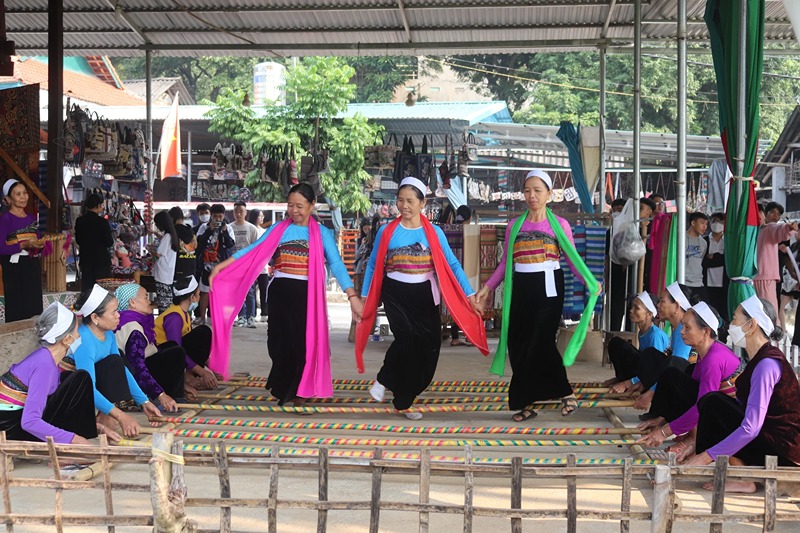
Bamboo pole dance of the White Thai people in Mai Chau (Source: Dan Viet Newspaper)
What is a bamboo dance?
At its core, bamboo dance follows a simple structure found in nearly every regional variant. Long bamboo poles are laid on the ground in pairs, and a group tapping out a steady rhythm slides the poles open and closed against each other or against a crossbar. Dancers step in and out of the gaps in time with that rhythm, and the challenge, and the fun, comes from timing your feet to avoid getting caught between the poles as they close.
Versions of this appear well beyond Vietnam. The Philippines has Tinikling, arguably the best-known bamboo dance internationally, India's Mizoram state has Cheraw, and Thailand has its own take called Lao Kra Top Mai. Each grew out of a distinct local culture, even though the basic mechanics look similar from the outside.
Nhay sap: Vietnam's version of bamboo dance
In Vietnam, bamboo dance is rooted in the daily and ceremonial life of the Thai ethnic minority in the northwest. It traditionally appears at festivals, harvest celebrations, and moments of welcoming guests, and it has stayed part of everyday community life in Thai villages rather than becoming a strictly staged performance.
The setup involves two large bamboo poles placed a set distance apart to anchor a row of smaller poles laid across them, spaced roughly two hand-widths apart. Performers split into two groups: one group sits at either end of each pair of poles and taps them together in a 4/4 rhythm, while the other group dances through the moving gaps. The rhythm is deliberate rather than fast, which is part of what makes it approachable for first-time visitors trying it for the first time.
Why does nhay sap matter to the Thai communities?
Nhay sap is more than a dance that tests how quickly you can move your feet. In traditional community gatherings, it creates a shared rhythm between the people playing the bamboo poles and those moving through them. Everyone has to listen, coordinate and adjust to one another, which is why the dance is often associated with community spirit and togetherness.
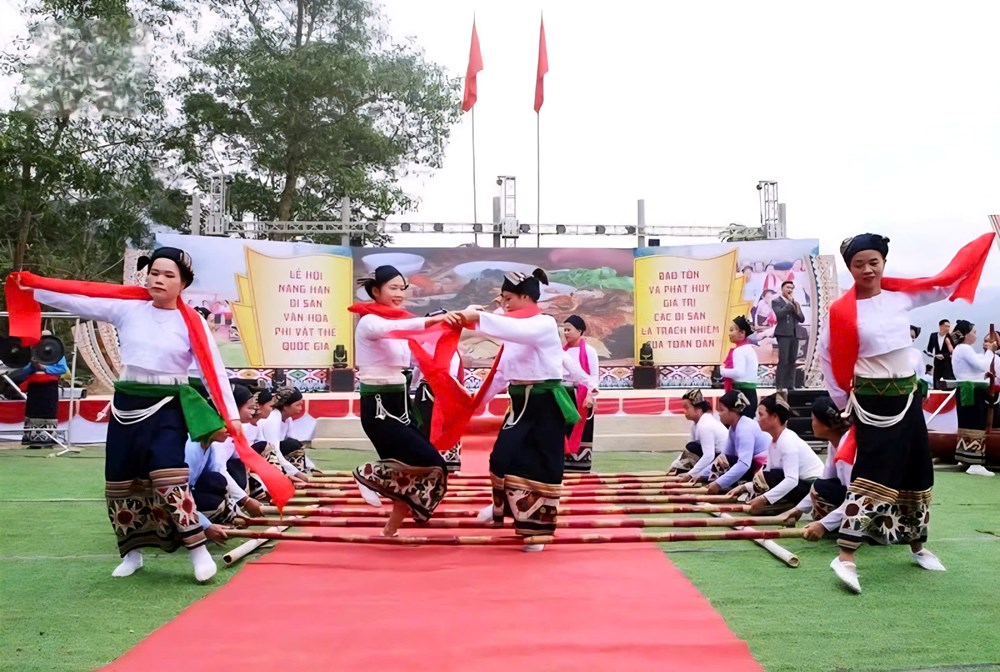
The bamboo pole dance holds profound spiritual significance (Source: Van Hoa Newspaper).
The bamboo poles themselves are made from an everyday material closely connected to rural life in the mountains. During celebrations and cultural gatherings, the sound of bamboo striking in rhythm helps create a lively atmosphere where locals and visitors can take part together. For travelers, joining the dance is therefore less about performing it perfectly and more about becoming part of the communal activity.
Where in Vietnam is nhay sap practiced, and a note on the region's new administrative map
Nhay sap is most closely associated with the Thai villages of Mai Chau, in Vietnam's northwestern mountains, an area long known for its terraced rice fields and stilt-house communities.
There's a practical detail worth knowing if you're researching the region online: as of July 1, 2025, Hoa Binh province, which historically included Mai Chau, was merged with Phu Tho and Vinh Phuc provinces into a single, larger Phu Tho province, with its administrative center in Viet Tri. Older maps, articles, and even some booking platforms may still reference "Hoa Binh" as a standalone province, so it's worth keeping this change in mind when planning a trip or looking up local information.
It's also worth noting that this same region is home to a large Muong ethnic community, particularly around Tân Lạc and Lạc Sơn, whose performing arts are distinct from nhay sap. Muong culture in the area centers on traditions like the Khai Hạ festival and Hát Thường Rang, Bộ Mẹng, a form of folk singing and storytelling recently recognized as a national intangible cultural heritage. The two traditions are sometimes lumped together simply because they come from the same province, but they belong to different ethnic groups with different histories.
How is a nhay sap performance set up?
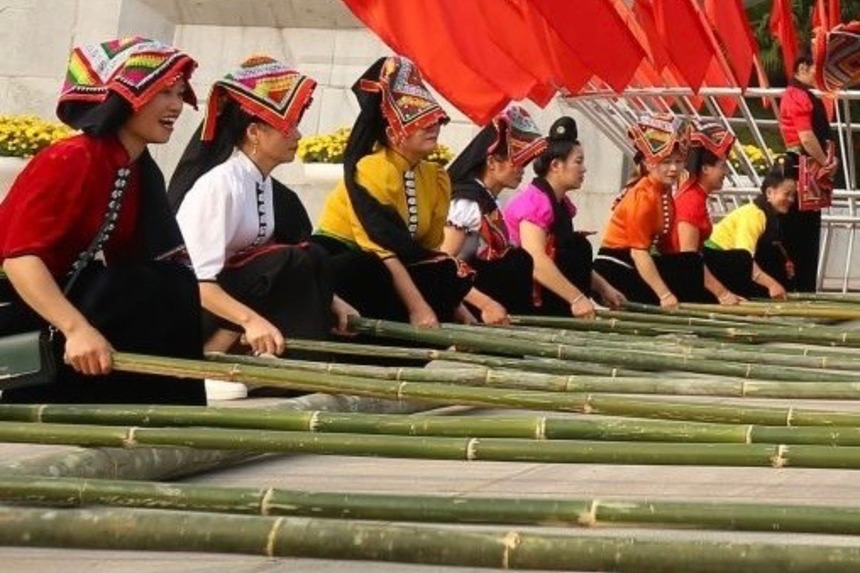
Equipment needed for the bamboo pole dance (Source: Van Hoa Newspaper)
A traditional nhay sap setup uses two types of bamboo poles. Two longer poles, known as sap cai, are placed parallel on the ground as the main supports. Several shorter poles, known as sap con, are laid across them to create the gaps that dancers move through.
The people controlling the poles usually sit at either side and move the bamboo poles together in a steady rhythm. The dancers then step between the opening gaps, moving from one space to the next as the poles open and close.
The setup itself is simple, but the timing matters. The poles need to move in coordination, while dancers have to anticipate the next opening rather than react at the last second. This is what turns a few pieces of bamboo into a surprisingly lively group activity.
How to experience nhay sap yourself in Mai Chau
The most reliable way to see nhay sap is in the community tourism villages around Mai Chau, such as Bản Lác and Pom Coong, where evening performances are a regular part of village life rather than something staged only for tour groups. Many homestays and resorts in the area also organize cultural evenings that include nhay sap, often paired with local food and music.
If you're invited to join in, a few basics help. Watch the rhythm for a moment before stepping in, keep your steps light rather than committing your full weight too early, and expect to get caught between the poles at least once. It's a normal part of the experience, and usually the moment that gets the most laughs from everyone watching.
How to join a bamboo dance if you've never tried it before
You do not need to know how to dance before joining nhay sap. The easiest approach is to let the rhythm guide your feet.
1. Watch before you step in: Stand outside the poles for a few cycles and watch when they open and close. Listening to the sound of the bamboo can be easier than trying to copy another dancer.
2. Start with small steps: Wait for the poles to open, step into the gap, and move to the next space on the following beat. Keep your movements light and avoid putting your full weight down too quickly.
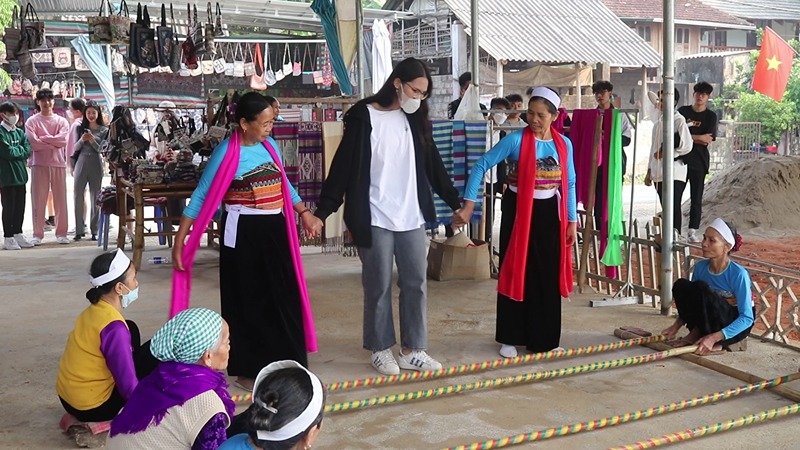
Local residents guide tourists in participating in the bamboo pole dance (Source: Dan Viet Newspaper)
3. Follow the rhythm, not the speed: If the people controlling the poles are moving slowly, stay with their rhythm. Once you are comfortable, the pace can gradually become faster.
4. Step out when the poles open: When you are ready to finish, wait for an opening and step clear of the poles rather than stopping in the middle.
Getting your feet caught between the poles is not unusual for beginners. In a typical cultural evening, a missed step is more likely to produce laughter than embarrassment.
Nhay sap vs. xoe dance: what's the difference?
Nhay sap and xoe dance are often performed together during cultural evenings in northwestern Vietnam, but they are not the same dance.
Nhay sap is built around bamboo poles. The focus is on timing and footwork as dancers move through the opening and closing poles. It is interactive and often invites visitors to join, making it one of the easiest traditional activities for travelers to try themselves.
Xoe dance, meanwhile, is strongly associated with the Thai people and is usually performed in a circle. The movements are more flowing, with dancers joining hands and moving together in a coordinated formation.
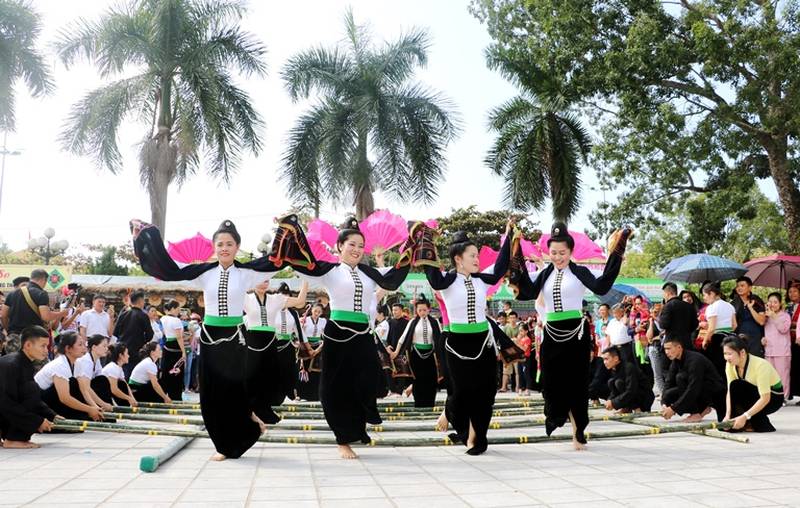
Bamboo pole dancing combined with Xoe dancing at a local festival (Source: Cong Thuong Newspaper)
If you attend a cultural evening in Mai Chau, you may see both. Xoe can create a more graceful, communal opening, while nhay sap often becomes the more energetic part of the evening, especially when visitors are invited to join.
Read more: Xoe Dance: A traditional dance of the Thai people
When is the best time to experience nhay sap in Mai Chau?
You do not necessarily need to visit Mai Chau during a major festival to try nhay sap. Cultural performances and community activities can take place throughout the year, with weekends and holiday periods often offering more opportunities to join organized evening programs.
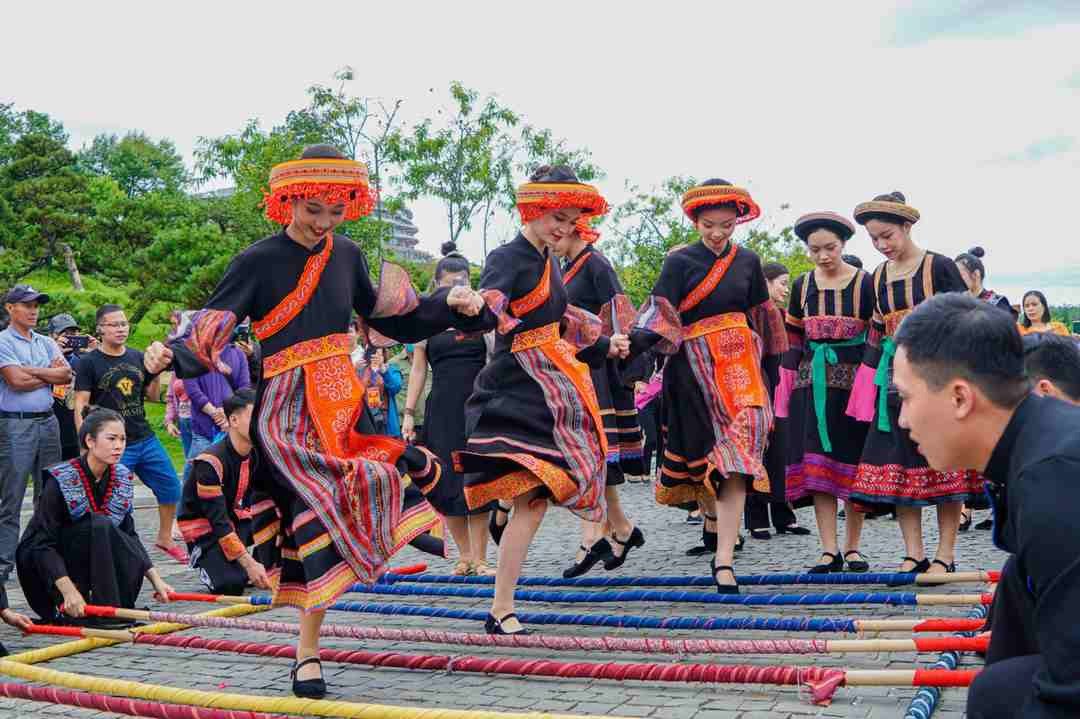
Bamboo pole dancing at the Mai Chau festival
The atmosphere can be particularly enjoyable during the cooler months from October to March, when evenings are comfortable for outdoor cultural activities. Around major holidays such as Tet, Reunification Day and International Workers' Day, or Vietnam's National Day, some community tourism sites and resorts may also organize larger cultural programs.
If nhay sap is one of the experiences you specifically want to have, check with your homestay, resort or local tourism site before arriving rather than assuming there will be a performance every night.
What should you wear for nhay sap?
Wear something comfortable that allows your legs to move freely. Trainers or secure sandals are a better choice than high heels or loose flip-flops, especially if you are joining rather than simply watching.
Long or restrictive skirts can also make the footwork harder. Some accommodation providers and cultural venues may offer traditional Thai clothing for guests who want to take part in the evening in a more local style.
If you are photographing a community performance, especially when taking close-up portraits, ask before photographing local performers. The activity is often informal and welcoming, but treating it as a cultural exchange rather than a staged photo opportunity is the better approach.
For travelers who'd rather not track down a village performance schedule on their own, Mai Chau Hideaway Lake Resort brings nhay sap rights to the property. Every Saturday from 8:00 PM to 10:00 PM, the resort's lobby turns into the stage for Mai Chau Cultural Night, an evening of khen flute music and traditional Thai and Muong dance performances, including the bamboo pole dance, set against the resort's stilt-house architecture on Hoa Binh Lake. It's paired with Golden Hour Souvenir Shopping, where handmade Thai–Muong items like brocade shawls, khan pieu scarves and traditional outfits are offered at a discount, so the evening doubles as a chance to pick up something made locally.
Because it runs as a standing weekly program rather than a one-off show for tour groups, it's an easy addition to a stay of any length, no separate booking or hunting down a homestay with the right schedule required.
Frequently asked questions
Is bamboo dancing the same in every country?
No. The basic mechanics of poles and rhythm are similar, but each country's version, nhay sap in Vietnam, Tinikling in the Philippines, Cheraw in India, developed independently and carries its own history, music, and meaning.
What is bamboo dance called in Vietnam?
It's called nhay sap, sometimes written as Mua Sap, and it's most closely tied to the Thai ethnic minority in Vietnam's northwestern provinces.
Where can I watch or join nhay sap in Vietnam?
Mai Chau is the most accessible place, particularly the community tourism villages of Ban Lac and Pom Coong, as well as many local resorts that host cultural evenings.
Is Mai Chau still in Hoa Binh province?
Not administratively. Since July 2025, Hoa Binh province was merged with Phu Tho and Vinh Phuc into a single, large Phu Tho province. Mai Chau now falls under this new provincial boundary, even though older references to Hoa Binh are still common online.
Is nhay sap difficult for beginners?
Not particularly. The rhythm is steady and repetitive, and most visitors pick up the basic timing within a few tries, even if they miss a step or two along the way.
Can children join nhay sap?
Yes. Children can join when an adult or instructor is there to help and the dancing area is safe and free of obstacles.
Do I need to know how to dance to try nhay sap?
No. You do not need formal dance skills. The main challenge is following the opening and closing rhythm of the bamboo poles and coordinating your steps.
What should I wear for nhay sap?
Choose comfortable clothes that allow easy movement and secure footwear. Avoid high heels, loose flip-flops and long skirts that could get in the way of your feet.