I still remember the exact moment I heard it: a deep, hollow thunk-thunk-thunk echoing across the rice fields as the sun dropped behind the limestone hills of Mai Chau. I had no idea what I was walking toward. By the end of that night, I'd witnessed one of the most captivating living traditions I've ever seen in Vietnam: the Keng Loong Mortar Dance.
What Is the Keng Loong mortar dance?
Before my trip, I tried googling "Keng Loong Mortar Dance" and found surprisingly little in English, so I asked a local guide to explain it to me properly. According to the Thai artisans of Mai Chau, "Keng" means "to strike," and "Loong" refers to a large wooden trough, traditionally carved from aged, sturdy timber so it produces a clear, resonant sound when struck. Put together, Keng Loong is essentially the art of rhythmically striking wooden pestles against a long trough.
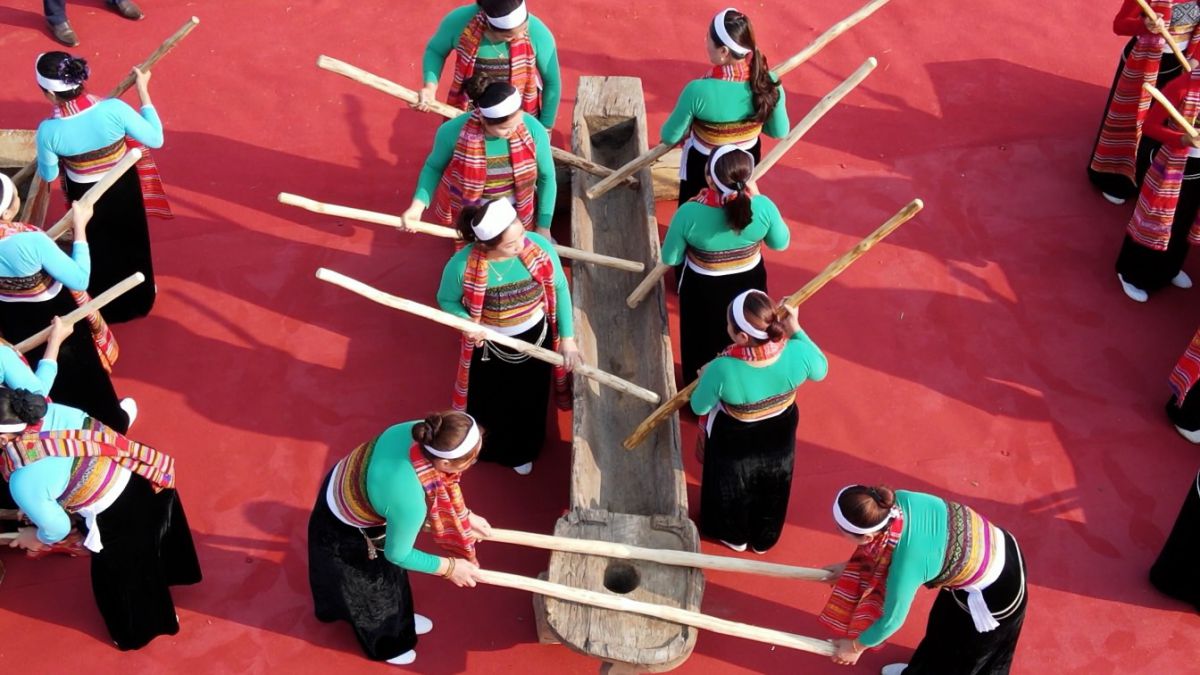
What is Keng Loong? Origins and cultural significance (Source: Lao Dong Newspaper)
What struck me most is that this isn't a performance invented for tourists. It grew organically out of daily life. For generations, Thai women here pounded rice in these troughs, and over time they began adding extra beats and rhythms to the process, partly to keep time, partly just to make the exhausting work of husking rice feel a little lighter.
Somewhere along the way, those practical rhythms evolved into a full performance art tied to festivals, courtship, and spiritual life. That's the part that got me: a farming chore literally turned into music.
Read more: Xoe Dance: A traditional dance of the Thai people
A recognized national Heritage, not just a tourist show
One thing that gave me real confidence this wasn't a staged "cultural show" was learning about its official status. On November 10, 2023, Vietnam's Ministry of Culture, Sports and Tourism issued Decision No. 3436/QĐ-BVHTTDL, officially inscribing the Keng Loong Mortar Dance of the Thai people in Mai Chau district onto Vietnam's National List of Intangible Cultural Heritage, under the category of social customs and beliefs.
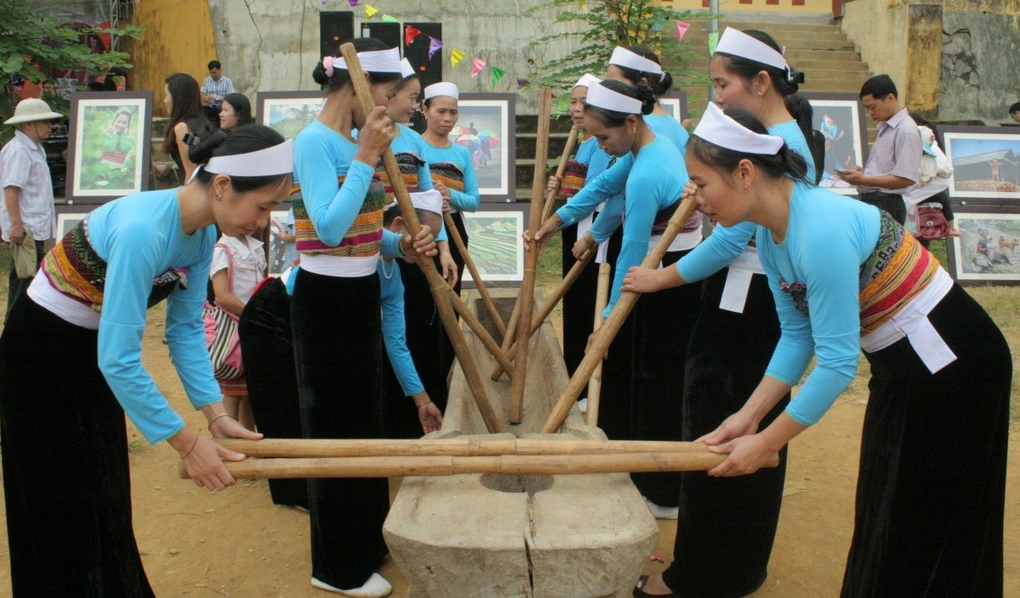
Keng Loóng recognized as National Intangible Cultural Heritage (Source: Lao Dong Newspaper)
The formal recognition ceremony took place on February 19, 2024, the 10th day of the first lunar month, timed to coincide with the opening of the Xen Muong Festival, one of the most important cultural events for the Thai community here. Standing in that same festival space months later, knowing generations of villagers fought to preserve this exact sound, gave the whole experience a weight I wasn't expecting.
Watching the performance: What it's actually like
About eight performers gathered around a wooden trough, split evenly into two facing lines of four. Two lead performers stood at either end of the trough, setting the tempo and coordinating the group. Everyone else held wooden or bamboo pestles, striking the sides of the trough in tightly synchronized patterns passed down through generations.
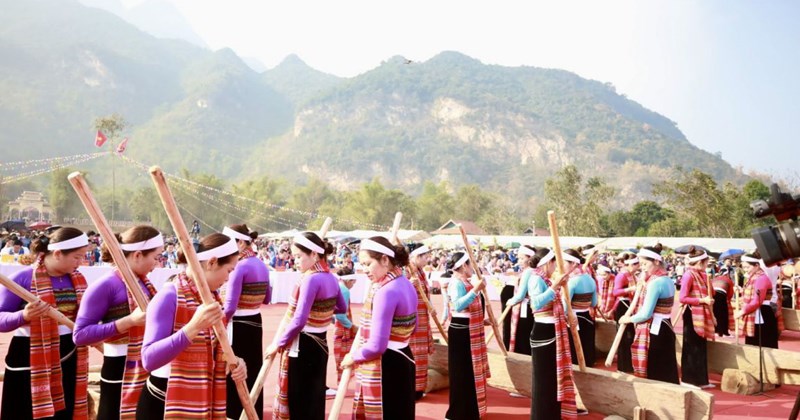
The Keng Loóng performance of the Thai people in Mai Chau (Source: Dan Tri Newspaper)
The rhythm built layer by layer, drums, gongs, and the wooden clack of the trough all interlocking, until the whole courtyard was buzzing with sound and movement. The performers weren't just keeping a beat; there was real choreography, pairs facing off, arms moving in mirrored arcs, punctuated by shouts and cheers from the crowd. Because it's performed as a group, precision matters. You can immediately tell this dance demands serious discipline and teamwork, not just enthusiasm.
I also learned there isn't just one "version" of Keng Loong. The rhythm and staging shift depending on the occasion, weddings, harvest celebrations, cockfighting festivals, or spiritual ceremonies, and the number of performers and length of the piece can vary depending on the size of the trough and the scale of the event.
Keng Loong and Thai spiritual life
What surprised me most was learning how deeply spiritual this dance really is. It isn't just entertainment. In Thai belief, the rhythm of the pestles carries wishes for favorable weather, a bountiful harvest, a peaceful village, and prosperity for the community.
You'll typically encounter Keng Loong during:
- The New Rice Festival: a celebration of the harvest and gratitude toward ancestors and the land
- Xen Ban and Xen Muong ceremonies: major community gatherings central to preserving Thai cultural identity
- Cha Chieng rituals: deeply traditional spiritual ceremonies
- Lunar New Year (Tet): where Keng Loong adds festive energy to community celebrations
The biggest of these by far is the Xen Muong Festival, held annually on the 9th and 10th days of the first lunar month. It's split into a solemn ritual portion, honoring ancestors and praying for peace, and a lively festival portion packed with folk games. Besides Keng Loong, I also watched locals compete in throwing "con" balls, tug-of-war, pole pushing, stilt walking, and traditional "xoe" dancing, alongside crossbow shooting, khen flute performances, and food stalls piled with Thai specialties.
Tips if you want to experience Keng Loong yourself
If my story has you considering a trip, here's what I wish someone had told me beforehand:
- Time it around the Xen Muong Festival (first lunar month) or a New Rice Festival if you want the full, large-scale version of the performance.
- Respect the spiritual side: During the solemn ritual portions, keep noise down and follow the organizers' lead. This isn't just a photo backdrop for locals.
- Ask before filming: Especially during ceremonial moments, a quick nod of permission goes a long way.
- Talk to the artisans: Some of my favorite moments came from chatting with performers about how the wooden trough is made and what each rhythm pattern means. If invited, try striking a beat yourself. I did, and I was terrible at it, but it was one of the highlights of my trip.
- Book accommodation early: Festival dates draw crowds, so lock in a place to stay well ahead of time.
Where I stayed: Mai Chau Hideaway Lake Resort
I based myself at Mai Chau Hideaway Lake Resort for this trip, and it turned out to be one of the best decisions of the whole itinerary. The resort sits on its own private peninsula on Hoa Binh Lake, in Suoi Lon Village within Tan Mai, roughly a twenty to thirty minute drive from Mai Chau's town center. Because the lake wraps around the property on three sides, almost every room opens onto open water framed by limestone mountains.
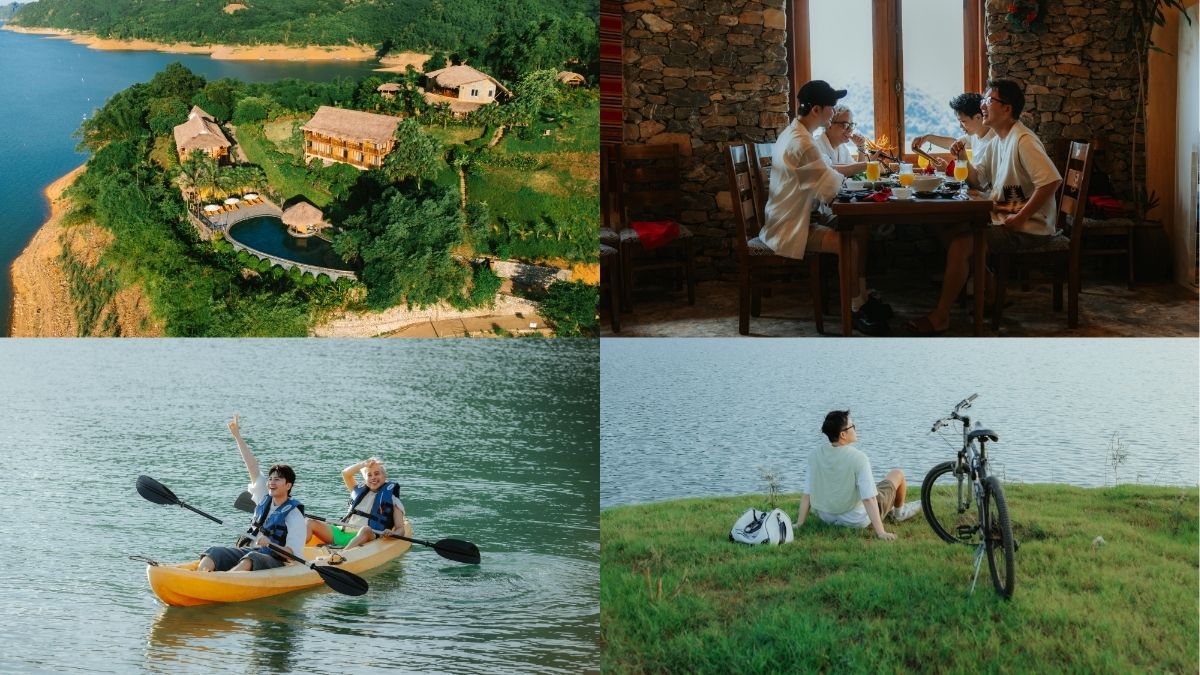
I didn't fully appreciate how dramatic this was until my first morning, when I stepped onto my balcony to watch fishing boats drift across still water with mist still sitting low on the ridges. The resort is intentionally small, with only 32 rooms, which keeps it feeling intimate rather than crowded, even during festival season when I visited and every other lodging in the district seemed fully booked.
The architecture leans deliberately rustic, echoing Northwestern Vietnamese buildings from the 1960s and 70s, with thatched roofs, dark wood interiors, and minimal, natural decoration rather than the glossy finishes of a typical chain hotel. The infinity pool, built from natural stone right at the water's edge, was probably the single most photogenic spot I found anywhere in the area, since from certain angles the pool's edge blurs directly into the lake itself.
Read more: Bamboo Dance in Vietnam: Inside the nhay sap Tradition of Mai Chau
My room had a private balcony with an unobstructed lake view, reliable air conditioning, a proper bathtub, and premium bedding, small comforts that made a real difference after long days out at the festival. The resort also runs its own ecotours and biking routes, and the front desk was genuinely helpful in timing my visit around both the Keng Loong performance and the opening of Xen Muong.
Location-wise, it's a short drive to Ban Lac Village, Gò Lào Waterfall, and the edge of Pu Luong Nature Reserve, which let me pair a festival day with a slower nature day without ever changing accommodation. For what it's worth as an outside check on my own impressions, the resort is independently listed as the top-reviewed property in Tan Mai on Tripadvisor, and guest scores across major booking platforms I checked afterward consistently sat in the "very good" range.
FAQ about the Keng Loong mortar dance
What is the Keng Loong Mortar Dance?
It's a traditional Thai performance art from Mai Chau, Vietnam, where performers rhythmically strike wooden pestles against a large wooden trough. It originated from daily rice-pounding work and evolved into a festival and ceremonial performance.
When was it recognized as a National Intangible Cultural Heritage?
It was added to Vietnam's National List of Intangible Cultural Heritage on November 10, 2023, via Decision No. 3436/QĐ-BVHTTDL. The official recognition ceremony was held on February 19, 2024, in Mai Chau.
Where can travelers see it performed?
At community-tourism Thai villages around Mai Chau, and especially during the annual Xen Muong Festival in the first lunar month.
What's the best time to visit for this experience?
The first lunar month, particularly around the Xen Muong Festival, offers the fullest experience. New Rice Festival celebrations are another good opportunity.
Can I combine this with a relaxing stay?
Yes. Staying at a resort like Mai Chau Hideaway Lake Resort lets you pair cultural experiences like the Keng Loong Mortar Dance with genuine downtime by the lake.
Watching the Keng Loong Mortar Dance wasn't just a cultural checkbox for me, it was a reminder of how something as simple as pounding rice can carry a community's entire history, faith, and identity. If you're heading to northern Vietnam, don't just pass through Mai Chau. Time your visit right, and you might just hear that same thunk-thunk-thunk that stopped me in my tracks.