The Black Hmong (H'Mong Den) are one of the Hmong groups living in northern Vietnam around Sapa and Lao Cai. But Black Hmong culture is not limited to Sapa: Hmong communities can also be found across Ha Giang and in the mountains around Mai Chau, where different Hmong groups have developed their own distinct traditions through generations of contact with neighboring ethnic communities.
So where can you actually find the Black Hmong in northern Vietnam, and how are they different from the Flower, White, and Red Hmong you might also hear about?
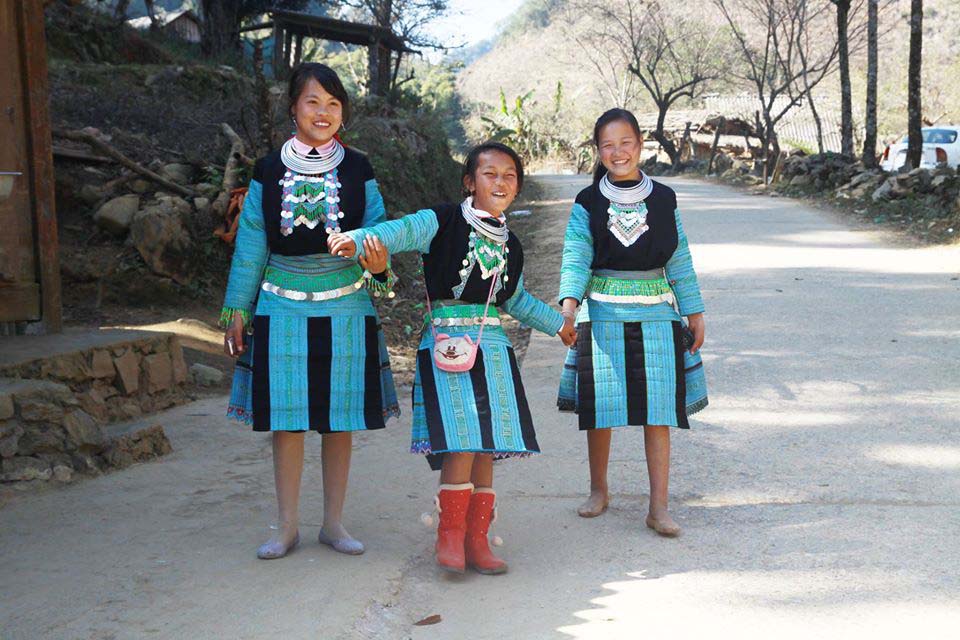
A Black Hmong People (Source: Craft Link)
Who Are the Black Hmong in Vietnam?
The Black Hmong, known in Vietnamese as H'Mông Đen, are a Hmong ethnic group living mainly in the mountainous areas of northern Vietnam. They are particularly well known around Sapa and nearby villages in Lao Cai, where their traditional indigo clothing has become one of the most recognizable parts of the local culture.
The name "Black Hmong" comes from their traditional clothing, not their skin color. Their clothes are traditionally made from hemp and dyed repeatedly with indigo, creating the deep blue or blue-black color that distinguishes them from several other Hmong groups. (Source: Vietnamonline.com)
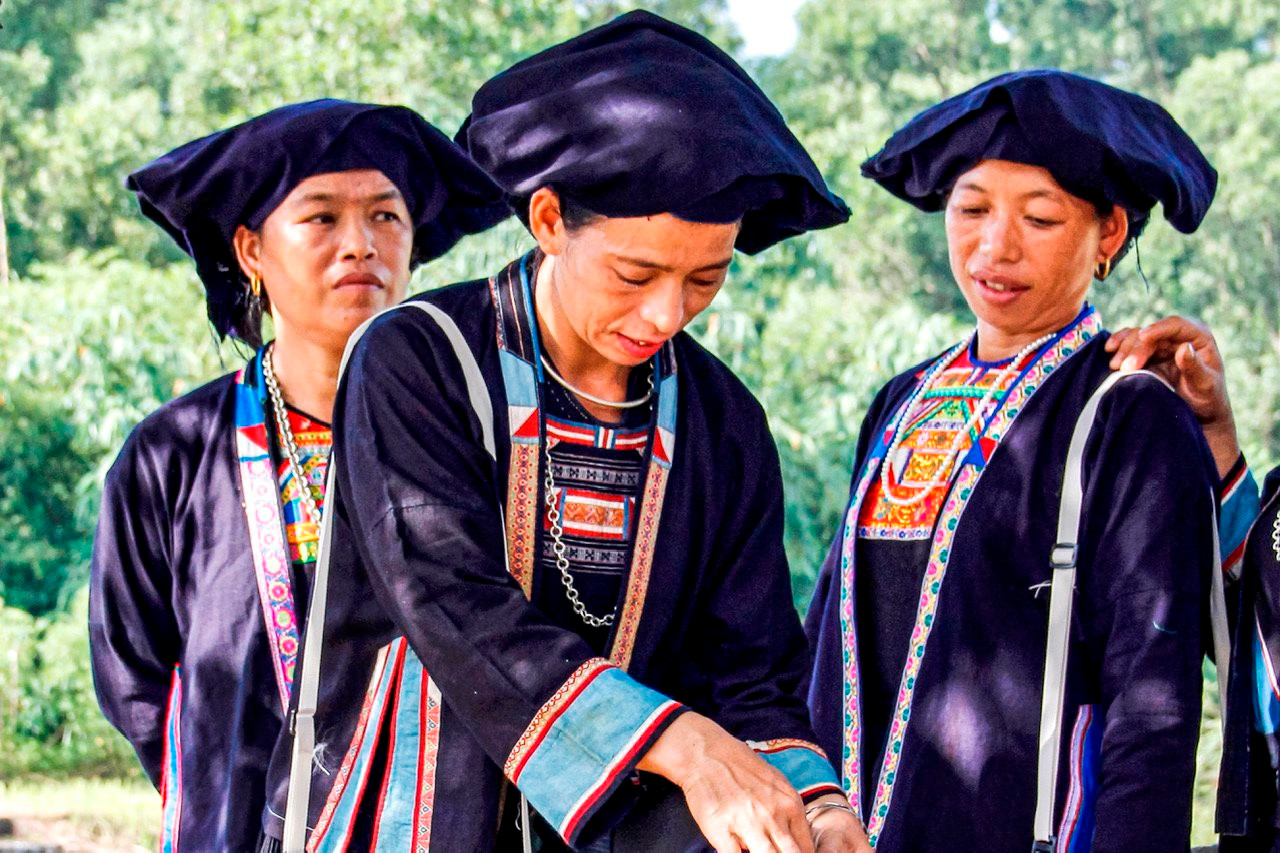
Black Hmong comes from the color of their traditional clothing: black (Source: Chuyen trang Phap luat Dan toc va Ton giao)
It is important to remember that Hmong is not a single, uniform cultural group. Different Hmong communities in Vietnam have developed their own clothing styles, textile techniques, customs, and traditions. They are commonly identified by names such as Black Hmong, Flower Hmong, White Hmong, and Red Hmong.
This becomes especially important when looking beyond Sapa. Pa Co and Hang Kia, near Mai Chau, are home to Hmong communities with different regional identities. Local cultural sources identify the Hmong in this area mainly as Blue Hmong and Red Hmong, while also noting cultural connections with Black Hmong. In other words, Pa Co and Hang Kia should not simply be described as another "Black Hmong village." (Source: Craft Link)
|
Quick facts
|
Details
|
|
Vietnamese name
|
H'Mông Đen
|
|
Ethnic group
|
Hmong
|
|
Best-known area
|
Sapa and surrounding areas of Lao Cai
|
|
Other Hmong regions
|
Ha Giang and other northern mountain areas
|
|
Traditional textiles
|
Hemp weaving and indigo dyeing
|
|
Traditional crafts
|
Hemp textiles, embroidery, batik, silverwork
|
|
Language family
|
Hmong-Mien
|
|
Religion
|
Animism and ancestor worship
|
Black Hmong vs. other Hmong groups: How to tell them apart
The Hmong people you meet in northern Vietnam may look quite different from one village to another. This is because Hmong is a broad ethnic group made up of several communities, each with its own traditions, clothing styles, and regional identity.
The Black Hmong are best known for their deep indigo clothing, traditionally made from hemp and dyed repeatedly with indigo. Their outfits tend to have relatively simple embroidery, with decorative details often concentrated around the collar, sleeves, and cuffs.
The Flower Hmong, commonly associated with areas such as Bac Ha and parts of Ha Giang, are known for more colorful clothing featuring bright embroidery, patterned skirts, and decorated headwear. The White Hmong are traditionally associated with lighter-colored clothing, while the Red Hmong are recognizable for the red details often found in their clothing and headwear.
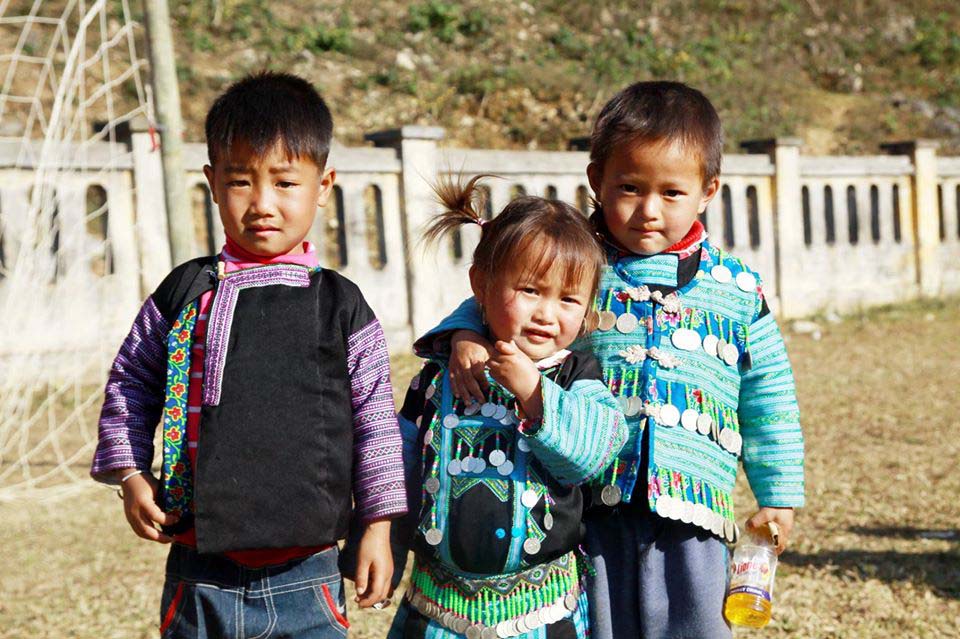
What is the difference between Black Hmong and other Hmong groups? (Source: Craft Link)
However, these names should not be treated as strict dress codes. Clothing styles can vary between communities and change over time, and cultural traditions can overlap where different Hmong groups live close to one another. In places such as Pa Co and Hang Kia near Mai Chau, for example, local Hmong communities have their own regional characteristics rather than simply fitting into the same cultural picture as the Black Hmong around Sapa.
For travelers, knowing these basic differences makes it easier to understand what they are seeing. Instead of treating every Hmong village as the same, you can recognize that each community has its own history, traditions, and relationship with the surrounding region.
|
Subgroup
|
Commonly associated color
|
Commonly associated with
|
|
Black Hmong
|
Deep indigo, near-black
|
Sapa, Lao Chai, Ta Van (Lao Cai)
|
|
Flower Hmong
|
Bright, multicolor embroidery
|
Bac Ha and parts of Ha Giang
|
|
White Hmong
|
Paler, lightly dyed hemp
|
Parts of Ha Giang and Lai Chau
|
|
Red Hmong
|
Red accents on collars, headscarves
|
Smaller communities in Lao Cai and Ha Giang
|
Note: these are commonly used travel and cultural descriptions rather than a strict ethnographic classification. Local naming and clothing traditions can vary by village and have evolved over time.
Where to find Black Hmong and other Hmong communities in Northern Vietnam
Sapa, in Lao Cai Province, is one of the best-known places to meet Black Hmong communities in northern Vietnam. Villages such as Cat Cat, Lao Chai, and Ta Van are located around the town and are easily reached by trekking routes. Here, travelers can see terraced rice fields, traditional indigo-dyed clothing, and local textile crafts in the same landscape that has made Sapa one of northern Vietnam's most popular destinations.
However, the experience varies from village to village. Cat Cat, in particular, has become highly commercialized after years of tourism, with many attractions and activities designed for visitors. Travelers looking for a less tourist-oriented experience may prefer trekking routes through Lao Chai, Ta Van, or other surrounding communities.
You can find Black Hmong and other Hmong groups in the northern Vietnam (Source: Craft Link)
Further north, Ha Giang offers a different setting. The province is home to several Hmong communities across a rugged mountain landscape, including areas around the Dong Van Karst Plateau. The region is better suited to travelers with several days to spare, especially those exploring by motorbike or joining a multi-day trekking tour from Hanoi.
But there is another option that is often overlooked in English-language travel guides: the Hmong communities in the highlands around Mai Chau, much closer to Hanoi.
This area also shows why it is important not to treat "Hmong" as a single cultural identity. The Hmong communities in Pa Co and Hang Kia are mainly associated with Blue Hmong and Red Hmong traditions, rather than simply being classified as Black Hmong. Their clothing, crafts, and local cultural practices reflect the history of Hmong communities living alongside other ethnic groups in the Mai Chau highlands.
Pa Co and Hang Kia: A different Hmong story near Mai Chau
Pa Co and Hang Kia offer a different perspective on Hmong culture in northern Vietnam. Located in the mountains above the Mai Chau valley, in what is now Phu Tho province (formerly part of Hoa Binh), these communities sit at nearly 1,000 meters above the valley floor and are wrapped in fog for much of the year. They are home to Hmong groups with their own regional identities and traditions, shaped by generations of contact with neighboring Thai and Muong communities. Local cultural sources identify the Hmong population here primarily in terms of Blue Hmong and Red Hmong traditions, while also noting cultural interaction with Black Hmong communities.
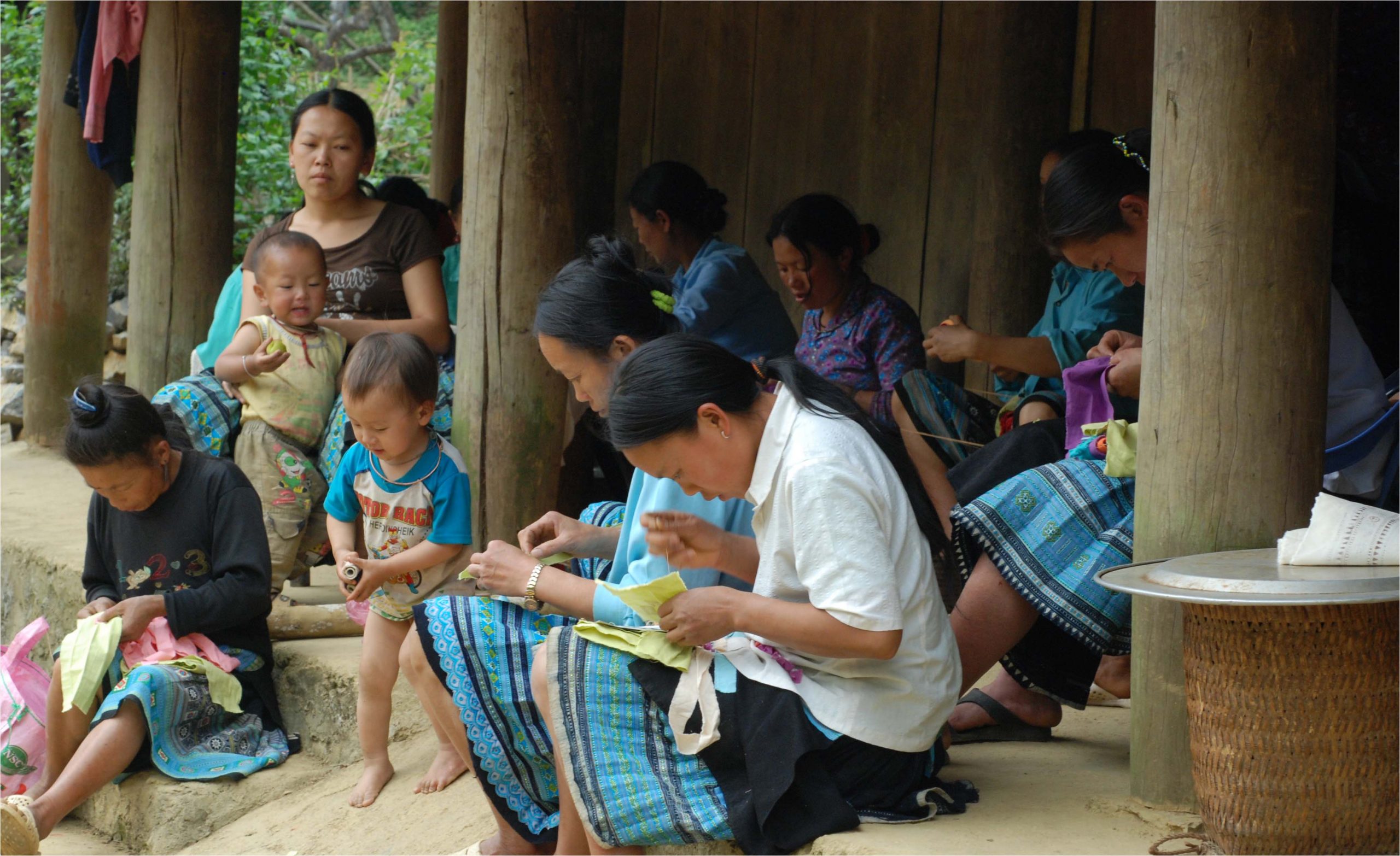
Pa Co and Hang Kia offer a different perspective on Hmong culture in northern Vietnam (Source: Craft Link)
That distinction matters: Pa Co and Hang Kia should not simply be presented as another "Black Hmong village" in the way Lao Chai or Ta Van are in Sapa. Instead, they show how Hmong culture has developed differently across northern Vietnam, even among communities that share the same broader ethnic roots and many of the same crafts- hemp cultivation, indigo dyeing, and wax-resist batik are all still practiced here. For travelers, this makes Pa Co and Hang Kia valuable not because they offer a hidden version of Sapa, but because they provide another way to understand the diversity within Hmong culture itself, away from the crowds.
- Sapa: Black Hmong, most accessible, most developed, most crowded
- Ha Giang: mixed Hmong communities, remote, dramatic scenery, needs 3+ days
- Pa Co & Hang Kia (near Mai Chau): Blue and Red Hmong traditions, quiet, close to Hanoi
The Sunday market at Pa Co, running roughly from 7am to 11am, is one of the best places in the area to see local textiles, clothing, and agricultural products change hands, without a souvenir stall built for tourists. If you are staying nearby, this half-day trip pairs naturally with a longer break at Mai Chau Hideaway Lake Resort, which runs a dedicated Pa Co Market Discovery tour along the scenic mountain road connecting the two areas.
Indigo, hemp, and wax: The living craft behind Black Hmong clothing
Every piece of Black Hmong clothing begins as a hemp plant, not a bolt of fabric from a shop. Hemp is harvested and dried in spring, then split by hand into thin fibers, a task women often do while walking between the field and home, winding the fiber around one hand as they go. Over the following months, that fiber is spun into thread and woven on simple wooden looms, a process passed down almost entirely through observation rather than formal teaching.
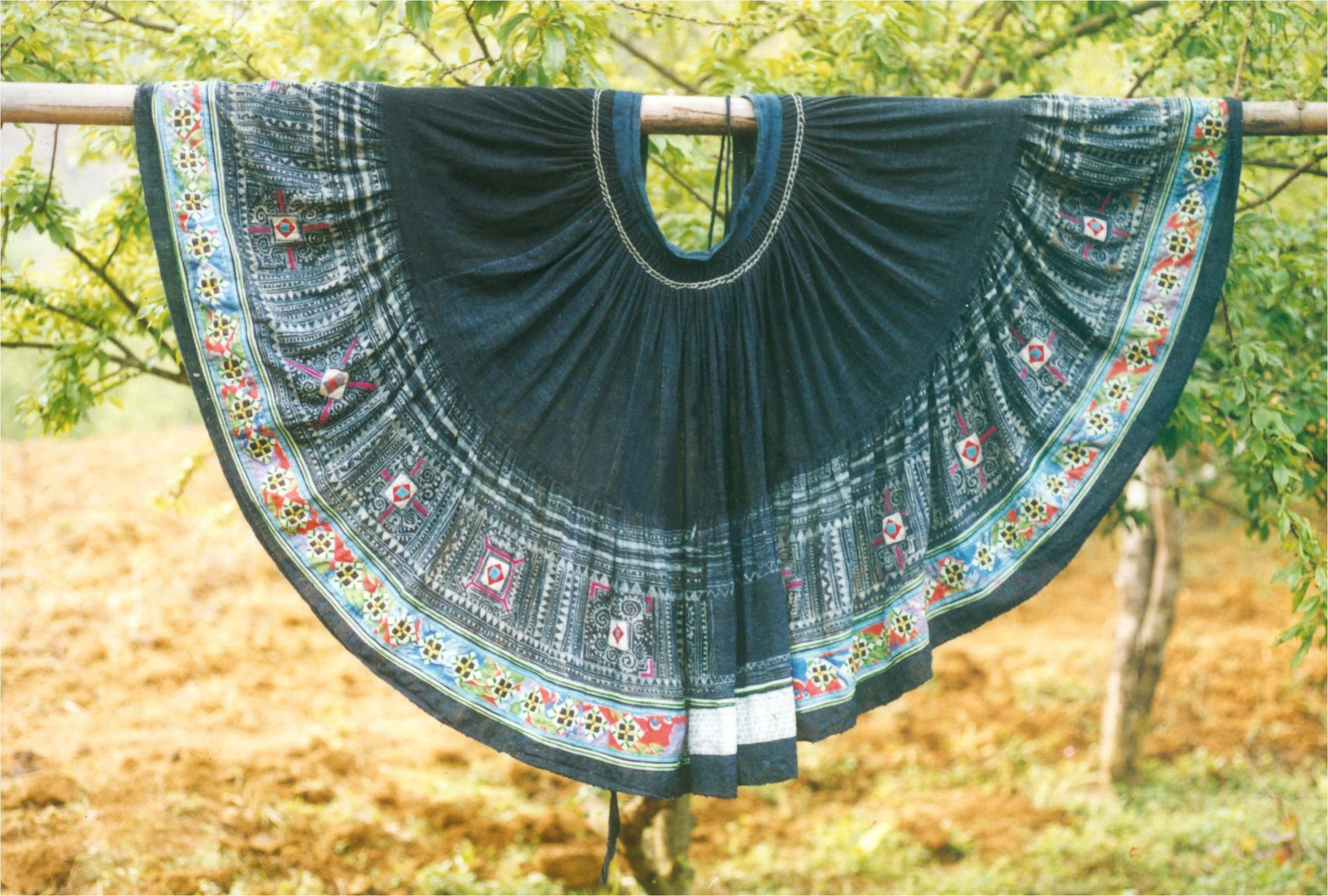
Patterns on the traditional attire of the Black Hmong people (Source: Craft Link)
Dyeing is where the fabric earns its signature color. Indigo leaves are fermented in wooden vats until they release a deep blue pigment, and the woven hemp is dipped, dried, and re-dipped over many days, sometimes for close to a month, until the color deepens into the near-black shade that defines the Black Hmong. It is slow, physical work, and the quality of a family's indigo often says as much about their skill and patience as the final garment does.
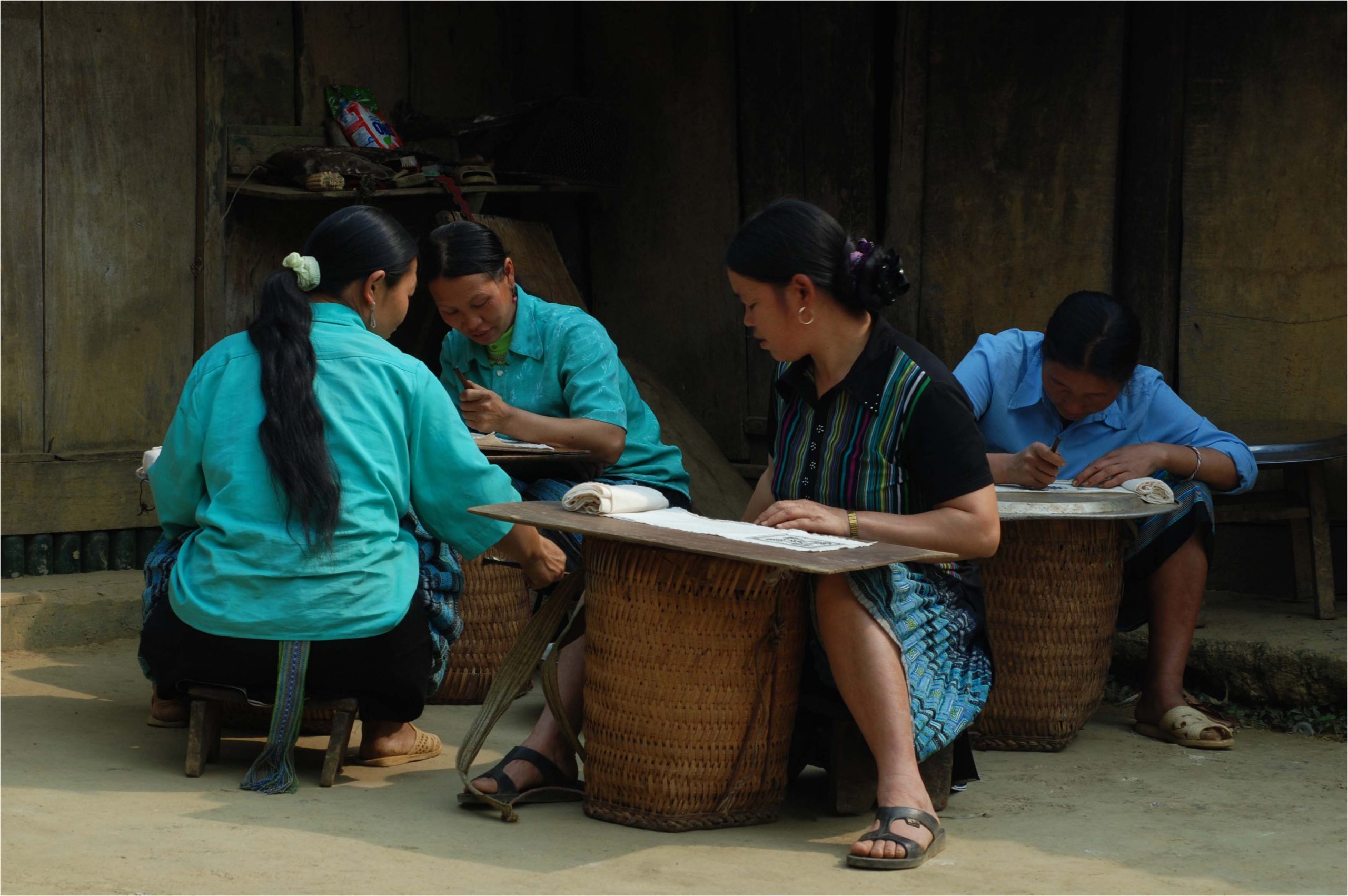
Beyond dyeing, many Hmong communities also practice wax-resist batik, using melted beeswax and a small metal tool to draw intricate geometric patterns onto cloth before it goes into the dye bath. Wherever the wax sits, the dye cannot penetrate, so once the wax is later melted away in hot water, a pale pattern is left behind against the dark indigo background. It is a technique that requires no drawn guide, no stencil, and no second attempt- the pattern lives entirely in the maker's memory and hand.
Read more: Mai Chau Periodic Market: A Guide to Local Markets and Cultural Experiences
Traditional dress, silver jewelry, and what the symbols mean
A finished Black Hmong outfit is more than clothing- it is closer to a wearable record of skill, status, and identity. Women's pleated skirts, sometimes made from as much as ten meters of fabric, are paired with an apron, an embroidered collar, and leggings wrapped from ankle to knee. Men's dress is simpler, usually a dark jacket and trousers with a small round hat, but no less deliberate in its construction.
Silver plays an outsized role in Hmong dress, appearing as necklaces, bracelets, and buttons stitched directly into collars and cuffs. Historically, silver functioned as a portable form of savings that a family could carry with them if they had to move, but it also carries protective meaning in Hmong belief, worn especially by children and during important ceremonies to guard against bad spirits. The heavier and more elaborate the silverwork, the more it traditionally signaled a family's wealth and standing.
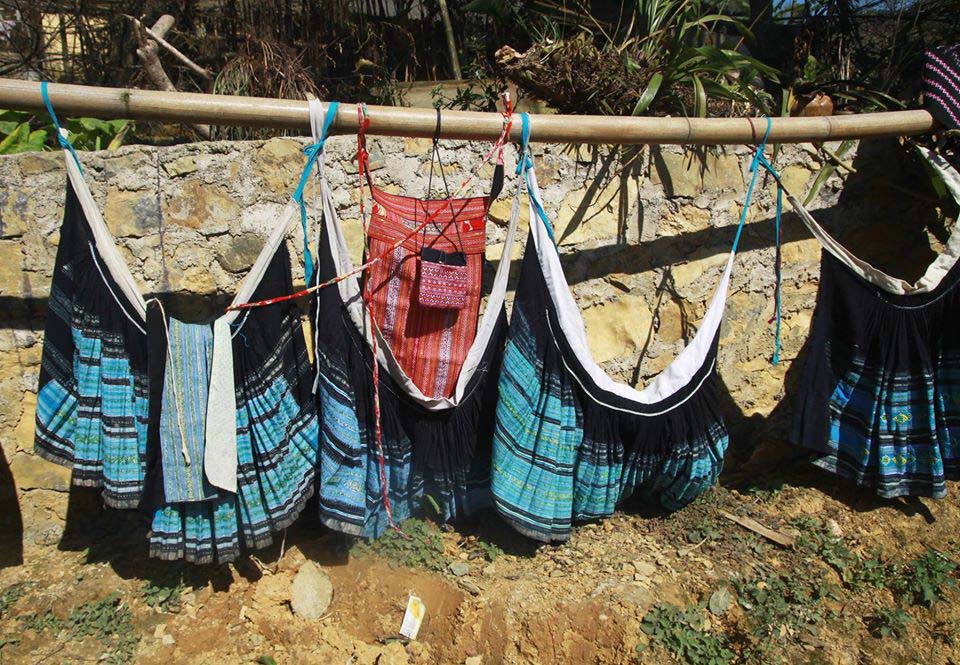
Traditional dress of Black Hmong under the sunshine (Source: Craft Link)
Embroidery motifs are rarely random. Spirals, ram's horns, and stylized flowers recur across generations, and many patterns are tied to specific clans or regions, which is part of why an experienced eye can often tell where in the mountains a particular skirt was made just by reading its stitching. For a young Hmong woman, the years leading up to marriage are often when she produces her finest embroidery work, wearing it during courtship festivals as a quiet display of skill.
Daily life, festivals, and beliefs
Away from the dye vats and looms, most Black Hmong families are farmers first. Rice, corn, and hemp are grown on terraced slopes that Hmong communities have carved into some of the steepest terrain in Vietnam, often at altitudes where rice cultivation would seem impossible to an outsider. Livestock, particularly pigs and buffalo, round out the household economy, and most families still build and repair their own wooden stilt houses using techniques handed down rather than learned from a manual.
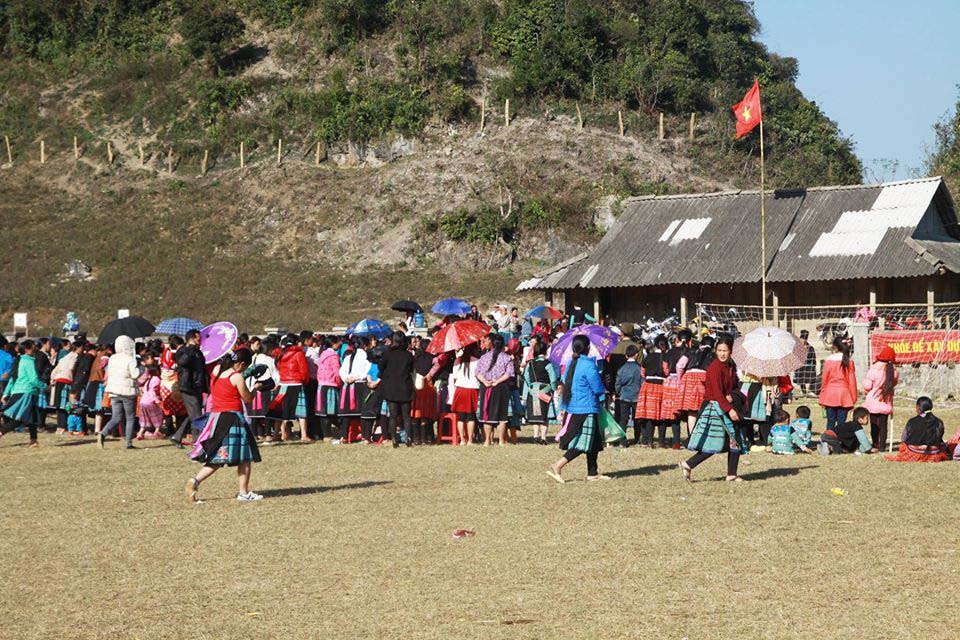
Traditional festival of Black Hmong Group (Source: Craft Link)
Hmong New Year, usually falling in December, is the most significant celebration of the year, running for several days after the harvest is complete. Courting rituals are woven into the festivities, most visibly in a traditional ball-tossing game called tu lu, where young men and women line up across from each other and throw a small cloth ball back and forth, using the exchange as a socially acceptable way to flirt and get to know a potential partner.
Spiritually, most Hmong communities practice a form of animism centered on ancestor worship and respect for spirits believed to inhabit the natural world. A village shaman, often called upon during illness or major life events, performs rituals meant to negotiate with these spirits on behalf of the family. This belief system shapes far more of daily Hmong life than most visitors realize, from how a house is built to how a wedding is arranged.
Read more: Muong culture: a journey through traditions and heritage
Visiting Black Hmong communities responsibly
Meeting Hmong families should feel like a visit, not a performance, and a few habits make a real difference in how that visit is received. Always ask before photographing someone, especially older women and children, and accept it gracefully if the answer is no. Buying handicrafts directly from the women who made them, rather than from a resale shop, sends income straight back to the family and supports the survival of skills like hand-spinning and batik that machine production has already replaced elsewhere.
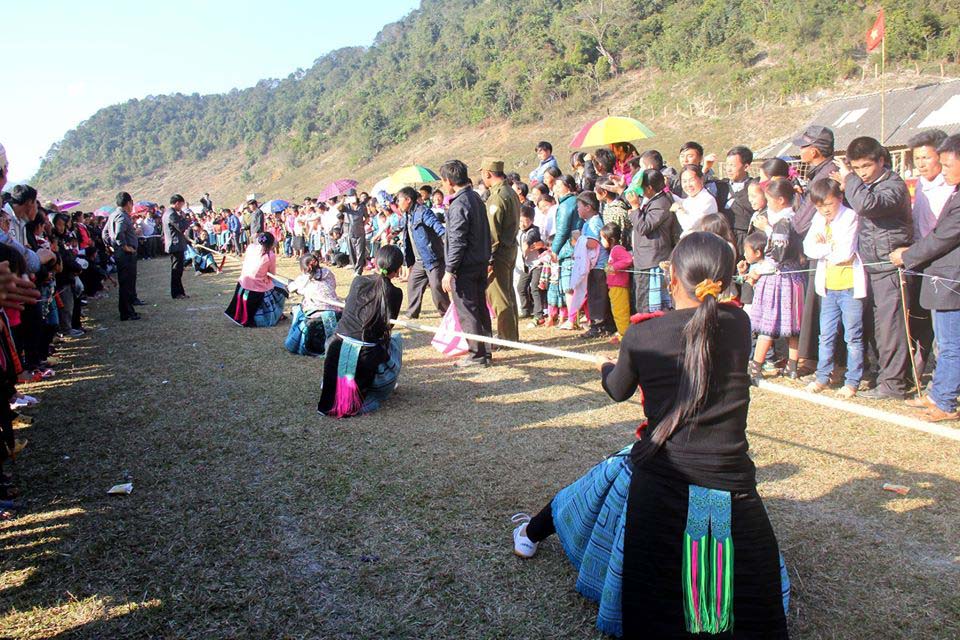
Black Hmong people are playing tug-of-war (Source: Craft Link)
One habit worth avoiding entirely is asking someone to put on "traditional costume" for a photo. For many Hmong women, especially in villages like Pa Co and Hang Kia, indigo clothing is simply what they wear on an ordinary Tuesday, not a prop reserved for visitors. Treating it as one reduces a living culture to a tourist backdrop, and most local guides will tell you it is the single most common misstep foreign visitors make.
Timing your trip also matters more than most people expect. Indigo dyeing traditionally takes place in August and September, so visiting during these months gives you a real chance of seeing dye vats in use rather than just finished fabric. From March to April, apricot and plum blossoms bloom across the hills around Pa Co and Hang Kia, adding a second, very different reason to visit outside the busier autumn trekking season in Sapa.
|
Best time to visit
|
Why
|
|
August - September
|
Indigo dyeing season; highest chance of seeing the process in person
|
|
November - April
|
Cool, clear weather; good for both Sapa trekking and Pa Co cloud-hunting
|
|
March - April
|
Apricot and plum blossom season near Hang Kia and Pa Co
|
Where to Stay When Exploring Hmong Culture Near Mai Chau
If Pa Co and Hang Kia sound like the kind of unhurried, uncrowded experience you are after, the practical question becomes where to base yourself. Mai Chau Hideaway Lake Resort sits on a private peninsula on Hoa Binh Lake, roughly a two-and-a-half-hour drive from Hanoi and within easy reach of both the Hmong villages above Mai Chau and the wider valley's Thai and Muong communities. Its eco-friendly, wooden stilt-style architecture was deliberately designed to echo the traditional building styles of the region's ethnic groups, so the connection to local culture starts before you even leave the resort grounds.
Recent guest reviews from international travelers consistently point to the same things: the quiet, lake-facing location well away from the noise of central Mai Chau, an infinity pool with uninterrupted mountain views, and a level of staff attentiveness that visitors from Canada, Thailand, the Czech Republic, and the United States have each singled out in their own words. For travelers weighing Sapa against Mai Chau, the resort also offers a genuinely useful comparison point: closer to Hanoi, gentler terrain, and a slower pace better suited to cultural immersion than serious mountain trekking.
Beyond the Pa Co market tour, the resort's tours and experiences page covers everything from kayaking on Hoa Binh Lake to cycling routes through Thai and Muong villages, making it straightforward to combine a Hmong cultural excursion with a broader look at the valley's ethnic diversity. Rooms across the property's six categories all open onto private balconies facing the lake, which makes the accommodation page worth a look before you finalize dates, especially in the cooler months when demand for lake-view rooms rises.
.jpg "Infinity pool at Mai Chau Hideaway Lake Resort overlooking Hoa Binh Lake at sunset, with mountains in the background")
Infinity pool at Mai Chau Hideaway Lake Resort overlooking Hoa Binh Lake at sunset, with mountains in the background
For travelers building a longer northern Vietnam itinerary, staying at Mai Chau Hideaway Lake Resort also solves a logistical problem many people underestimate: Sapa and Ha Giang both require long, tiring travel days from Hanoi, while Mai Chau sits close enough for a relaxed weekend trip that still delivers genuine Hmong cultural contact, alongside Thai and Muong village life, without the multi-day commitment.
FAQs about Black Hmong culture
What does "Black Hmong" mean?
It refers to the color of traditional dress, not skin color. Black Hmong women wear hemp clothing dyed repeatedly in indigo until it turns a deep, near-black shade.
Are Black Hmong and Flower Hmong the same group?
No. They are related but distinct branches of the Hmong ethnic group, distinguished mainly by the color and style of traditional dress and the regions they settled in.
Where can I see Black Hmong people outside Sapa?
Ha Giang province has significant Black Hmong populations alongside other Hmong groups. Travelers looking for a quieter, closer alternative to Hanoi can also visit Pa Co and Hang Kia above Mai Chau, though the Hmong communities there are locally associated with Blue and Red Hmong traditions rather than Black Hmong specifically.
Is it respectful to take photos of Hmong villagers?
Always ask first. Many Hmong communities are used to visitors, but consent matters, and children and elders in particular should never be photographed without permission.
How many days do I need to visit Hmong villages near Mai Chau?
A half-day trip covers the Pa Co Sunday market comfortably, though staying two to three nights allows time to also explore surrounding Thai and Muong villages in the valley.