Muong culture offers a fascinating journey into the customs, spiritual beliefs, and everyday life of one of Vietnam’s iconic ethnic communities. From indigenous stilt houses and folk music to vibrant festivals, local cuisine, and ancient rituals, Muong heritage reveals a deep connection between people, nature, and community. Exploring Muong culture is more than sightseeing - it is an opportunity to experience living traditions and better understand the rich cultural landscape of Vietnam.
The Muong people and their cultural identity
The Muong are one of Vietnam’s 54 ethnic groups, possessing a distinct identity shaped by their way of life, spiritual customs, and harmony with nature. This heritage is showcased through ancestral stilt houses, folk melodies, seasonal festivals, agricultural practices, and oral folklore passed down across generations.
The Muong primarily reside in northern and north-central Vietnam, with major populations in Hoa Binh, Phu Tho, and Thanh Hoa. Hoa Binh is widely recognized as the cultural heartland of the Muong, making it a prime destination for travelers eager to experience this unique legacy.
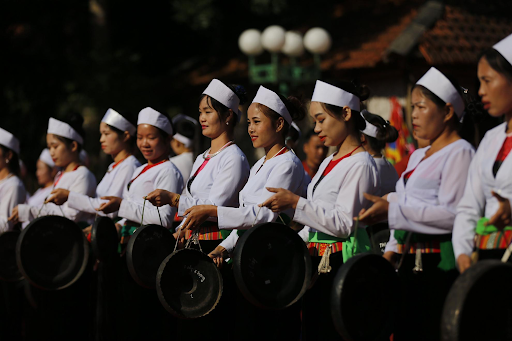
Muong people (Source: Nhan Dan newspaper)
While maintaining a distinct identity, Muong culture shares noticeable parallels with neighboring communities in northern Vietnam, such as the Thai, H’Mong, and Dao. Their way of life is strongly tied to nature, community bonds, and ancestral reverence, yet their languages, dress, traditional arts, and local customs remain clearly differentiated. The breakdown below highlights these unique characteristics and shared traits, particularly around Mai Chau
|
Cultural aspect
|
Muong
|
Thai
|
H’Mong
|
Dao
|
|
Traditional homes
|
Mainly stilt houses
|
Wooden stilt houses
|
Earth or wooden houses
|
Earth or wooden houses
|
|
Community life
|
Strong family and village ties
|
Strong village-based community
|
Close-knit mountain communities
|
Strong family and ritual bonds
|
|
Heritage arts
|
Mo Muong, folk songs, oral epics
|
Xoe dance, folk songs
|
Khen flute, folk songs
|
Folk songs and ritual performances
|
|
Festivals and customs
|
Agricultural rituals and gong rituals
|
Xen ban, Xen muong and Xoe celebrations
|
Seasonal festivals and community rituals
|
Initiation rites and folk festivals
|
|
Cultural highlights
|
Mo Muong and oral heritage
|
Stilt houses, Xoe dance and village culture
|
Khen, embroidery and colorful clothing
|
Traditional clothing, rituals and handicrafts
|
Read more: Mai Chau Cultural Travel Guide
What makes Muong traditional life unique?
Daily life in Muong communities is reflected through distinctive forms of clothing, housing, music, and community activities. Some of these features may resemble those of neighboring ethnic groups, but Muong culture has its own expressions, particularly in women's clothing, Muong stilt-house architecture, folk singing, and community games.
Muong ethnic costumes and textile crafts
Customary Muong women's clothing is relatively simple in design but has distinctive details. A typical outfit includes a long black skirt, a fitted white or light-colored blouse, and a white headscarf. The waistband and accessories can add decorative elements while maintaining the characteristic understated appearance of Muong dress.
Textile weaving is natively practiced by Muong women, who produce fabrics for clothing and household use. Compared with some northern ethnic groups known for highly colorful embroidery, Muong textiles tend to have a more restrained appearance. Heritage patterns and weaving techniques are passed down within families, making textile work an important part of Muong cultural knowledge.
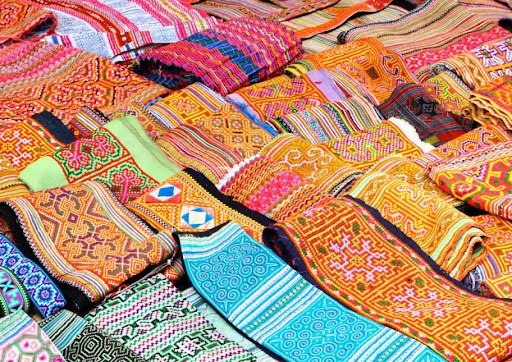
Intricately woven Muong ethnic textiles
Today, these heritage garments are most commonly seen during festivals, ceremonies, cultural performances, and community events. They allow visitors to recognize Muong identity through clothing while also showing how indigenous craftsmanship has been preserved.
Muong houses and traditional village life
Traditional Muong houses are closely associated with stilt-house architecture, although their design can vary between communities. The raised structure helps adapt the home to the local environment, while the space underneath can be used for storing agricultural tools, livestock, or household items.
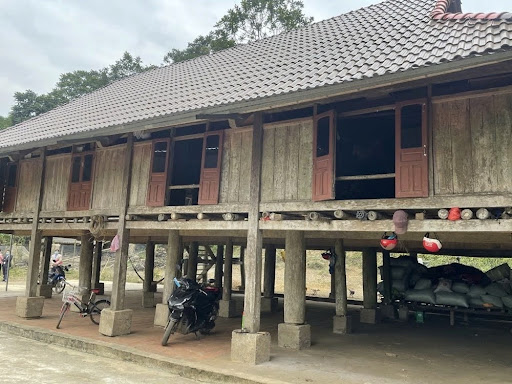
Muong’s house (Source: Vanhoa Newspaper)
The layout of Muong’s house also reflects family life. The main living area is used for daily activities and receiving guests, while different areas of the house may have specific functions. The house therefore serves not only as accommodation but also as a place where family customs and social relationships are maintained.
A particularly interesting feature is the relationship between the house and the surrounding village. Muong hamlets have historically developed alongside rice cultivation, forests, streams, and agricultural land, demonstrating the community's close relationship with its natural environment. This combination of housing and agricultural life provides an important insight into ancestral Muong society.
For visitors, stepping into a Muong stilt house offers a more sensory experience of local life. The wooden floor, open structure, and natural materials create a simple and airy atmosphere, while the sounds of village life can be heard around the house. Staying overnight can make the experience even more memorable, especially in the evening when the pace of life becomes quieter.
Muong folk music and musical instruments
Muong folk music is intrinsically linked with oral storytelling and community life. Instead of being performed only as entertainment, native songs can be used to tell stories, express emotions, communicate messages, and preserve cultural knowledge
One notable form is Muong folk singing, which can appear during social gatherings, festivals, and other community occasions. Native musical instruments are also used to accompany singing and cultural performances. Their role is particularly important in maintaining the atmosphere of communal celebrations.
For example, gong music has a place in traditional Muong cultural activities and ceremonies. The sound of gongs can bring members of the community together and create a shared atmosphere during important occasions. Experiencing Muong music in a local cultural setting therefore offers more than a performance; it provides an insight into how music functions within community life.
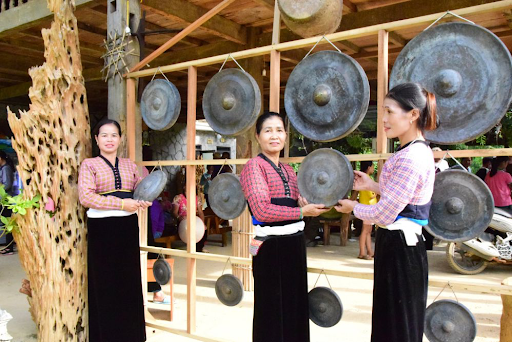
Muong women performing with traditional ethnic gongs (Source: Collected)
Hearing the gongs in person is different from simply reading about them. Their deep, resonant tones can travel across an open village space, creating a powerful communal atmosphere. When several gongs sound together, the rhythm becomes part of the surrounding environment rather than simply a musical performance.
Read more: Ban Ngoi Village: The Muong Hamlet Hiding Inside Hoa Binh Lake
Folk games and community activities
Traditional Muong folk games are often associated with festivals and communal celebrations, where they provide opportunities for people to gather and interact. Rather than focusing only on competition, these activities emphasize participation and social connection.
Muong’s festivals may include lively community games such as tug-of-war and ball-throwing competitions. In tug-of-war, two teams pull against each other while supporters gather around and cheer, creating a lively and collective atmosphere. Ball-throwing games, meanwhile, require participants to aim and throw toward a target, adding a playful element to the celebration. These activities encourage people of different ages to participate together rather than simply watch a performance.
Although some of these games are shared with other communities in Vietnam, their role within Muong festivals and village gatherings contributes to the local cultural experience. Today, visitors may encounter traditional games during Muong cultural festivals or community events, offering a more interactive way to experience local life.
Read more: Mai Chau Tet travel guide for a peaceful spring escape
What beliefs and customs shape Muong culture?
Muong culture is shaped by a rich system of spiritual beliefs, rituals, and oral heritage passed down through generations. These customs not only reflect the spiritual life of the Muong people but also reveal how they understand human origins, the natural world, and the relationship between different realms of existence.
Muong beliefs and ancestral worldview
Ancestral Muong beliefs reflect the community's understanding of different realms inhabited by humans, spirits, and ancestors. These ideas are preserved through unwritten stories, rituals, and the Mo Muong, forming an important part of the Muong spiritual worldview.
Muong folk beliefs are deeply intertwined with the sky, earth, mountains, rivers, forests, and natural forces. Nature was not simply viewed as a place to live but also as part of a spiritual world. Certain natural spaces could therefore hold sacred significance and become associated with stories, customs, or rituals.
These beliefs help explain many aspects of Muong culture and are particularly reflected in Mo Muong. The Muong worldview therefore exists not only through spiritual beliefs but also through rituals, oral epics, and collective cultural memory.
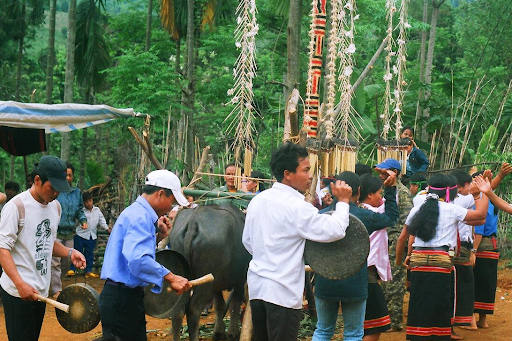
Spiritual ritual ceremony with gongs (Source: Redsvn)
Mo Muong and the role of the ritual specialist
Mo Muong is one of the most distinctive elements of Muong cultural heritage. It is a large body of oral ritual texts performed during important ceremonies, particularly funerals. These rituals are conducted by a ritual specialist, who has extensive knowledge of traditional beliefs, customs, and ceremonies.
Mo Muong goes far beyond funeral prayers. Its verses contain creation myths, history, folk wisdom, and philosophical views on the universe. The ritual specialist plays a vital role in keeping this heritage alive, transferring knowledge orally across centuries.
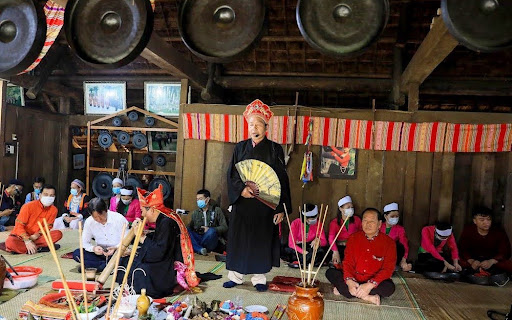
Mo Muong (Source: Nhan Dan Newspaper)
The Muong epic and oral storytelling
The Muong also have a rich tradition of epic narratives and oral storytelling, with De Dat De Nuoc being one of the best-known examples. This epic tells stories about the origins of the earth, water, humans, and the Muong community, reflecting how the Muong traditionally understood the formation of the world.
These stories are valuable not only as folk literature but also as a way of preserving collective memory, beliefs, customs, and social values. Through oral transmission, this knowledge has been passed from one generation to another and remains an important part of Muong cultural life.
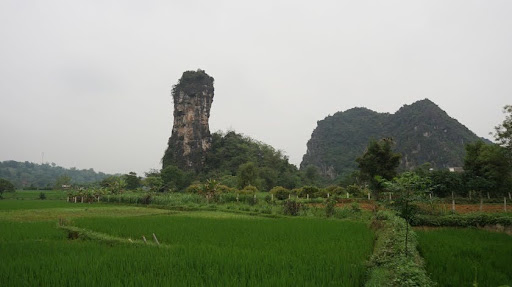
Muong Bi Flag Column Mountain, Tan Lac, Hoa Binh is an archaeological site of Hoa Binh Culture, the homeland of the epic De Dat De Water (Source: Congdan Khuyenhoc)
Together with Mo Muong, these epic narratives and oral storytelling form a distinctive cultural heritage. They allow later generations to understand the origins, worldview, and identity of the Muong people while helping preserve their culture into the present day.
Ways to discover Muong culture near Mai Chau
If you want to do more than simply hear about Muong culture and instead see it, touch it, taste it, and experience it firsthand, Mai Chau, Hoa Binh, is an ideal starting point. Although Thai culture is more prominent in central Mai Chau, its location makes it convenient to explore Muong cultural sites in the wider Hoa Binh area, including the Muong Cultural Space Museum and nearby Muong communities. From Mai Chau, travelers can combine their stay with short trips to these places, making it easier to experience the region's wider ethnic and cultural diversity.
Enjoy Muong cuisine at Mai Chau
Muong cuisine is tied to the mountainous environment and agricultural lifestyle of Hoa Binh. Authentic dishes often use locally available ingredients such as sticky rice, bamboo shoots, freshwater fish, pork, wild herbs, and seasonal vegetables. Simple cooking methods allow the natural flavors of these ingredients to stand out.
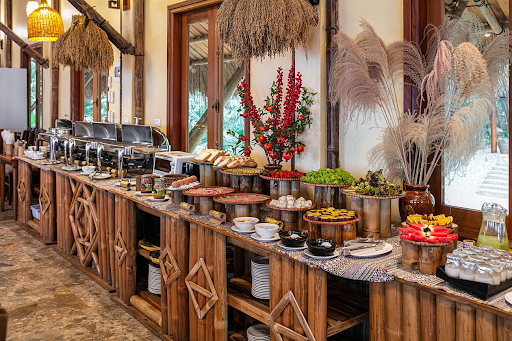
Bamboo Restaurant at Mai Chau Hideaway
At Bamboo Restaurant at Mai Chau Hideaway, travelers can enjoy regional dishes while taking in views of Hoa Binh Lake. The restaurant uses local ingredients and features Northwest Vietnamese flavors, making it a convenient place to explore the region's cuisine during a stay in Mai Chau.
Travelers can also ask about the ingredients and origins of each dish to better understand the local food culture. However, since Thai cuisine is particularly prominent in Mai Chau, not every local specialty should be considered uniquely Muong. Those specifically interested in Muong cuisine can ask the restaurant or local guides which dishes are associated with Muong communities.
Visit the Museum of Muong Culture Space
The Museum of Muong Culture Space in Hoa Binh provides a deeper introduction to Muong heritage through historical objects, architecture, artworks, and cultural materials.The entrance fee is around 30,000 VND per person. It offers visitors an opportunity to learn about different aspects of Muong history and ancestral life.
The museum helps illustrate how the Muong people have native lived, worked, expressed their beliefs, created art, and organized their communities. Traditional houses and everyday objects can also help visitors understand the close relationship between Muong culture and the local environment.
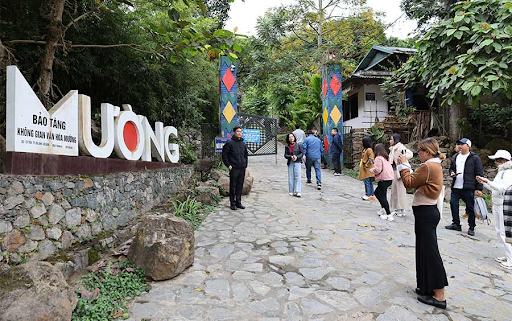
Entrance of the Muong Cultural Space Museum in Hoa Binh (Source: Vietnamtourism.gov)
For travelers staying in Mai Chau, visiting the museum can add historical and cultural context to their trip. Since Thai culture is particularly prominent in Mai Chau, exploring Muong heritage elsewhere in Hoa Binh provides a broader understanding of the ethnic diversity and cultural landscape of the region.
Read more: Discover the Muong Cultural Space Museum – A place preserving the essence of Muong culture in Hoa Binh
How is Muong culture preserved in modern Vietnam?
Preserving Muong culture today goes beyond maintaining ancient practices. Cultural education, research, and documentation help record ancestral knowledge, oral heritage, and historical materials while introducing younger generations to their cultural roots.
Digital media and modern technology also provide new ways to share Muong heritage. Time-honored tales, music, images, and cultural knowledge can be recorded and presented through websites, videos, digital archives, and social media, making them more accessible to younger audiences.
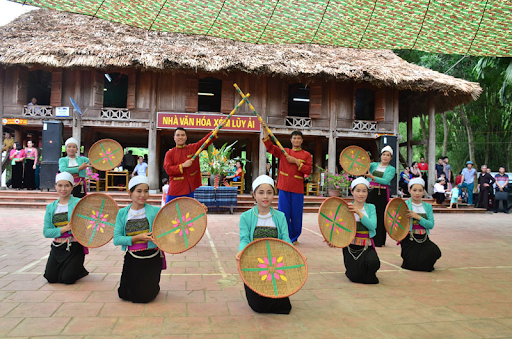
Traditional Muong dance performance during a local cultural festival (Source: Vietnamtourism.gov)
Most importantly, Muong communities remain at the center of cultural preservation. When local people actively participate in documenting, teaching, and sharing their heritage, Muong culture can continue to develop alongside modern life without losing its distinctive identity.
Want to experience Mai Chau beyond sightseeing? Stay at Mai Chau Hideaway Lake Resort for a peaceful lakeside retreat surrounded by mountains and Hoa Binh Lake, where you can enjoy regional dishes at Bamboo Restaurant, discover the natural beauty of the area, and explore the local culture and customs of Mai Chau. Book your stay at Mai Chau Hideaway and experience the authentic charm of Northwest Vietnam.
FAQs
How can I travel from Mai Chau to Hoa Binh?
By motorbike, taxi, or private car. The journey to Hoa Binh City takes around 1.5-2 hours.
How much does it cost to travel from Mai Chau to Hoa Binh?
A motorbike rental costs around 150,000 - 250,000 VND/day, while a private car costs about 1,000,000 - 1,500,000 VND/round trip.
How much does a Muong cultural experience cost?
Expect around 300,000 - 1,000,000 VND/person, depending on entrance fees, meals, activities, and guide services.
Should I visit independently or join a tour?
Independent travel is cheaper and more flexible; a tour is easier if you want transport and a local guide.
How long should I spend exploring Muong culture?
Allow one full day for a day trip or 1 - 2 days for a more immersive experience.
Can I visit Muong cultural sites from Mai Chau in one day?
Yes. Leave early and focus on one or two main sites to avoid rushing.
What can I experience during a Muong cultural visit?
You can explore villages, traditional houses, local food, handicrafts, and community-based cultural activities.